Saturday, September 11, 2010

Read My Clothes


To judge from the names on the t-shirts and shorts I wear when out running, you would think I’d managed to cram attendance at several prep schools and a couple of Ivy League colleges into my formative years. Also, you might have the impression that when I was at Princeton I played lacrosse as I had done throughout my time at Choate (or was it Groton?), but when I transferred to Yale, my sport shifted to hockey. Go Bulldogs!

Now there is a fairly innocent reason for this misleading impression: I am not so much Ivy as Junior League material. That is, my budget-conscious wife picks up a lot of athletic wear for me at thrift shops run by this latter league. There guys named Chip who really did play lacrosse at institutions like Choate and Princeton tirelessly donate their clothes so that posers like me can run around pretending we did. This is a charity you won’t find written up in anyone’s social diary, a sharing of prestige that is all the more admirable for being anonymous. But don’t think we posers aren’t grateful!

Of course, my eclectic running wardrobe could also suggest that, like J.D. Salinger's Holden Caulfield and countless real-life ne’er-do-wells, I was kicked out of a series of fancy schools. “What? Did you blow up the library in the other two?” an acquaintance who noticed me sporting the insignia of my third school in a single week once interrupted my run to ask me.

“Worse. I set fire to the stables. But that’s how I got such glowing recommendations for this one. Didn’t you know that in prep school the more you screw up, the more people want to help you move on?”

In fact, this is a time-honored principle in the corporate world as well and thus an important way in which prep school does prepare you for this world.

But the real question is whether, on the strength of my shorts and t-shirts, I could actually be considered a preppy. Granted, such pretensions to preppiness might have been easily dismissed back in 1980 when Lisa Birnbach’s “The Preppy Handbook” was published. At least nowhere in the men’s clothing section of this book have I been able to find an entry for “castoffs.” But in Birnbach’s recession-era “True Prep” I did find such an entry. Only it was called “vintage,” and I was pleased to see that the thrift shop near where I live in New Jersey had made her “country-wide listing of great places to check out to incorporate vintage looks with your basic uniform.” I was also encouraged by a an interview with Birnbach (“Ivy Style” April, 2010), where she suggested that, as far as being preppy goes, what someone is wearing may not be so important as their having a proper “attitude of disregard” toward it.

If this is the case, my athletic wear comes out way ahead of a pair of taped together loafers. I am like a canvas onto which various school colors have been flung with reckless abandon, a billboard advertising competing brands all at once or at least in close succession.

The irony is that there is only one place I could have learned to dress with such disregard, and that is prep school. Yes, beneath all my posing, I am something of the real deal, having spent several Salinger-esque years at a Washington, DC Episcopal school for boys, though I never played lacrosse or blew up anything. At this school, with its strict dress code, future captains of industry and large government bureaucracies grew comfortable in the attire destined for them. They did this by wearing their mandatory ties flung over their shoulders and their mandatory suit jackets often not at all as they scuffed their loafers against all manner of surfaces, including desk tops, fellow classmates, and on one notable occasion the roof of the science building.

The lesson I took from all this was that no one is too young or immature to don the uniform of a social caste. Now for a while I worried that my own kids might not figure this out in public school, but my fears turned out to be groundless. On a recent trip to DC, I was pleased to watch what happened when a cute blonde woman wearing a colorful Lilly Pulitzer dress and clearly bound for Georgetown or Capitol Hill sat down next to my 6-year-old son on a bus.

After giving his t-shirt a mischievous once-over(I am not the only one for whom my wife scouts Junior League shops), she asked, “Do you go to Princeton?” Without even so much as pausing to consider whether she might be out of his league, he flirted right back at her with a smile that seemed to say, “Princeton? Sure. Class of 2025.”

A “chip” off the old block.

Friday, June 11, 2010

Survival of the Fittest: Bend it Like Baker

Ever wonder why you didn't compose your first symphony at age 8? Or know from the same age that you were going to grow up to be an international soccer star and marry a model/singer whose nickname is synonymous with high-end fashion and taste? According to the recently published "Bounce" by Matthew Syed, what separates the rest of us from youthful prodigies like Mozart and David Beckham is not genes, genius, or the fact that people didn't have names like "Trend" or "Haute Cuisine" where we were growing up, but 10,000 hours of practice. This statistic explains some lags in my own development, since it is around 9,962 more hours than I put in with either the violin or soccer.

"Dad, what sports were you good at as a kid?" one of my children asked me the other day after I'd helplessly watched a soccer ball he'd just kicked sail past me on our front lawn. My mind drew an awkward blank as I stooped down to retrieve the ball from a neighbor's bushes.

"I mostly played soccer," I finally said as I tried to kick the ball back to him in such a way as to look both effortless and like I'd had the full 10, 000 hours of practice.

Now we both watched helplessly as the ball, seemingly possessed of a mind of its own, flew up onto the low-hanging roof of another neighbor's porch, then rolled off it, narrowly missing the said neighbor's car, to end up (eventually) in the middle of the street.

"So soccer was like your best sport?" Clearly, he hoped not.

"Hey, I was bending it. You know, like Beckham. You could do that too if you practiced more."

I thought he looked discouraged, as if no amount of practice would enable him to pull off a trick shot like that in one of his own games at Floods Hill or the Meadowlands. So, following the time-honored parental principle of do-as-I-say-not-as-I-used-to-avoid-doing-myself, I launched into my spiel about how while he and his brother spent Saturday mornings watching reruns of "Tom and Jerry," David Beckham would have been outside repeating the same shot over and over until he got it right. After that, young Beckham would have gone to his room and promptly started work on his symphony.

"Thing is, Dad, when we play, we're trying to score goals, not kick the ball off the field and into a tree."

"Never mind goals. When done properly," I said, remembering one incident in particular, "that shot can bring the whole game to a stop."

This incident took place in 1974, a year before the Brazilian three-time World-Cup champion, Pele, joined the New York Cosmos and began to stir up American interest in soccer. Still, at the small Episcopal school I attended, we weren't waiting around for him. Our P.E. teacher had taken the job working with us 11-year-olds to supplement his income as a star player for the newly formed Washington Diplomats. (Imagine having to do that in England or Brazil!) Under his guidance the balanced sports program at St. Patricks Day School consisted of uninterrupted, World-Cup-inspired soccer followed by more of the same.

Mr. Kurt, as we called him, was in his twenties but really just a big kid filled with enthusiasm for the game. The only problem with this enthusiasm was that it was not accompanied by much awareness of his strength in relation to our own. Every now and then, to show us how it was done, he'd let loose with what must have been a 50 mph kick, scattering children and small woodland creatures for miles around.

"Got past every single one of you!" he'd announce as we emerged from our crouch positions.

Under these circumstances, of course, the last thing you wanted to be was goalie. If you played fullback, as I did, you could always say you had flung yourself out of the path of the oncoming ball to cover one of the opposing players, preferably the one standing as far away from the goal as possible. The only possible hitch was during a direct free kick, the shot for which Beckham would later become known. Here fullbacks would be drafted to make up the "human shield" standing between the kicker and the goalie.

Mr. Kurt left these kicks to one of us until the day the temptation to show us how it was done became irresistible. I remember us all lining up in front of the goal as if before a firing squad.

"Watch the spin!" he instructed us.

"If he hits you in the wrong place," the kid standing next to me said, "you'll never have children."

This was a sobering thought for us even at that age. Hands moved into protective positions.

Now Mr. Kurt was, I don't think, consciously trying to hit anyone. He probably figured it would be a cinch to place enough spin on the ball that it curved around a wall made up of trembling 11-year-olds and landed in the goal. But I wouldn't rule out the possibility that at some level he was venting some frustration too. After putting in his own thousands of hours learning to do what he loved, he had to spend several afternoons a week with us in order to make ends meet. It was just his bad luck to have been born an American soccer star rather than one from a right-thinking country where fans cared enough about the game to lose control and clobber one another during the exciting parts.

At any rate, as he cocked his foot and pivoted into the ball, most of us opted not to watch but rather closed our eyes, expecting soon to find ourselves sprawled out on the ground and having some bad news for our future spouses. Instead, there was a popping sound, and, when the daylight returned, we found Mr. Kurt staring off at something to his far left.

His foot must have slipped because the ball had made an unexpected detour, crossing the school parking lot, though, like my own shot, missing the cars. Instead, it had smashed the window of the French classroom where we were due in half an hour.

"Mon dieu!" we heard Madame Aubert scream. This was followed by an outpouring of Gallic invective.

"OK, which one of you wants to go get that ball?" joked Mr. Kurt, trying to keep up his jaunty sportsman's demeanor in the face of the shouting from the window and our stunned silence.

No one moved, and even he looked a little amazed at just how much the ball had curved.

"What's she saying?" he asked, but we shook our heads. We were only up to unit 8 in "Le Cours Francais."

As he trotted off in his blue track suit to find out, he told us to keep practicing and I would imagine he was offering himself the same advice.

After 10,000, what's a few hours more?

Sunday, May 23, 2010

Survival of the Fittest: The Karate Dad


It was an experience that every creaky-jointed, middle-aged parent who takes up a martial art should have. Over the summer I had read that the 1984 "Karate Kid" (movie debut of South Orange's own Elisabeth Shue!) was going to be remade with Jackie Chan playing the role of self-defense mentor to the boy who finds himself in over his head at what must be the School for Insane Bullies and their Victims. The original, starring Pat Morita as Mr. Miyagi, the elderly sage with an awesome back kick and a unique method for combining karate training with automobile upkeep ("Wax on! Wax off! Daniel-san!"), was one of my youngest son's and my favorite movies, and I wanted to be the first to tell him the news.

"Guess what? 'The Karate Kid' is being remade. And guess who's playing the Mr. Miyagi character?" I burst out when I picked him up at Marshall School.

He looked up at me and in all seriousness asked, "You?"

Now I am not claiming that at this point in my own training I could dispatch a group of attackers (at least reasonably alert ones) with quite the smooth precision of Mr. Miyagi. Nor have I figured out a way to disguise basic household chores as martial arts training, though I am working as hard on this as learning how to defend myself. "Load dishwasher! Unload dishwasher!" These moves, I have been trying to convince all three of my kids for some time, are really powerful blocks.

But I'd like to think that my first-grader wasn't entirely off the mark either. Since taking up Tae Kwon Do five years ago and becoming a black belt this year, I have felt a marked improvement in my chances of fulfilling a lifelong dream: a role in a martial arts flick that would allow me to participate in at least one group fight scene.

Now this may seem a stretch for a mature martial artist who does not happen to be Jackie Chan. But unlike other youth-obsessed action genres, where we are all too often relegated to trying to blow up the hero via remote control, martial arts movies do have non-sedentary roles for members of the older generation. There are not many of these roles, and so competition is fierce. But the opportunities for an actor to expand his range are tremendous. Look for the upcoming remake of "The Sound of Music" with Steven Seagal as Captain Von Trapp, high-kicking nuns and Nazis who literally fly through the air while the kids sing "Edelweiss."

We can't of course all be Captain Von Trapp or Mr. Miyagi. I would settle for the role of an airborne Nazi, and those who know me well would probably call it typecasting. Or perhaps, should "The Karate Kid" be remade for a third time, I could play an aging bully, one who, after 30 years of failed algebra tutorials, is still around in 10th grade to torment each year's crop of new students. That is, I could unless it takes so long for this third "Karate Kid" to come about that the filmmakers have to resurrect the character of Mr. Miyagi's father for me. Still, this would only be further proof that the ability to spin on one foot while knocking an enemy senseless with the other knows no age.

When I watch martial arts flicks, I am always on the alert for the white-haired, thoughtful gentleman who has gone unnoticed until a melee breaks out. He is not the brash guy who, already before anything much has even happened in the plot, is to be found snapping tire irons in half with his front teeth. Rather, this gentleman is likely to be minding his own business in some quiet cafe, perhaps in this day and age checking his e-mail for a communication from one of this great-grandchildren. In my case, should the screenwriters go with my actual day job, he would be in the middle of teaching a college seminar on 17th-century poetry. But once the kicks start flying, down goes the laptop and out the window go the notes on John Donne and metaphysical wit. He is soon shaking it up with the best of them.

So though I haven't had much luck thus far, I live in the hope that Hollywood will someday return my own e-mails and calls. In the meantime, I study the classics (Bruce Lee, not Shakespeare) and train hard, not only with kicks and punches but zinger lines like "You have offended my family, and you have offended a Shaolin temple!" or "Time will tell whose fist speaks loudest: yours or mine." There is also paternal wisdom to be dispensed at crucial moments, and I have been working on what I will say when one of the younger, less wise characters in the film seeks my counsel.

"You have lived many more years than I have. What should I do?"

Drawing on my experience as a dad, I would probably advise him to leave his brother's stuff alone and not tell his sister that her outfit looks like something "you'd feed animals at the zoo."

"I mean about the vicious warlord/gangster trying to kill me."

My advice would remain unchanged. Vicious warlords/gangsters come and go—are indeed sometimes interchangeable—but I have yet to see a feud over legos ever really end.

Then comes the inevitable question: "Can you train me?"

"Ah, Daniel-San, can Miyagi train wind to blow when it forget? Can Miyagi train tree to grow when too busy thinking other things to do what supposed to do?"

"Is this," I can see my young Jedi struggling to crack my code, "about the dishwasher?"

Miyagi have hope for him.

I hear that makeup can do wonders to hide a receding hairline and alter other features that might detract from my cinematic appeal. I've also been told that stunt coordinators can make even the most worn-out dad look as if he's able to leap over furniture, fences, and perhaps several parked cars to eliminate villains in a series of fluid, dance-like motions. But with this kind of dialogue, "You?" is a question none of my kids will have to ask when they see me on the big screen. It should be pretty obvious that it's me.

Saturday, May 1, 2010

Survival of the Fittest: Black Belt Professor, Or Why Teaching is the Ultimage Martial Art


I do not normally have to wear protective gear or hold my fists in the ready position when I face students. Most of the time, the students are seated or—if I’m having an off day—slumped in their chairs while I go on about the syllabus material or some equally important topic like my own favorite places to sit in the library and cafeteria and how they are sometimes taken. “Is that going to be on the test?” worried students will ask after I’ve managed to inject a lengthy personal note into what otherwise might be a rather dry discussion of a poem or play. But so far there has been no rioting in the aisles.

Now here I was trying to figure out how to distract this large, helmeted guy in his mid-20s long enough to land a punch within shaving distance of his upper lip and thereby win a point in our “no-contact” karate sparring match. Most likely, he was having similar thoughts about me. It didn’t help that, although his face was familiar, I couldn’t remember his name, or the class in which we’d spent so many joyous hours together. This had all the signs of turning into the kind of “non-productive encounter” I had in theory learned to avoid the time I attended an all-day workshop to help teachers improve their classroom communication skills.

Meeting one of your exes in the dojo is the top safety issue for every college professor who takes up a martial art, even if on weekdays that dojo doubles as the gym of Maplewood Middle School and the martial arts program is under the safe auspices of the South Mountain YMCA. Your mind races to recall the grade that you gave the student, and if it is in the “B-” neighborhood or lower, it adds some urgency to your blocks. If you ever made a sarcastic comment about an excuse the student spent days crafting, ducking, though technically not a part of karate, may be in order.

As it happened, though, along with his name, I was drawing a blank about his grade too. C+? A-?

“Professor Baker, right?” the student had reintroduced himself as we waited for the signal to commence hostilities. “Nate Howard. I was in your class on Greek tragedy.”

“Oh yes,” I said, trying to keep things positive, “that was a good class.”

I thought I detected a frown behind the helmet. Perhaps tragedy hadn’t turned out to be all that he’d hoped.

“I wrote this 12-page paper on ‘purgatorial motifs in Hamlet and—"

“Begin!” shouted the teacher. Before I had a chance to find out what the rest of the motifs were or point out that Greece had yet to claim Shakespeare as its own, the fight was on. His first kick, which was aimed right at my groin, made me realize that his paper was not likely to have been in the “B-” range. It had probably been closer to a “D.” His second move, an elbow feint followed by a finger-swipe that nearly took out my left eye, confirmed my suspicions.

“Hey, it’s no contact!” I reminded him. Face moist from exertion, he just glared at me and threw a punch. This time I blocked his arm as hard as I could, trying to send a clear message that, as both a scholar and a professional, I would not give in to threats or intimidation. Still, he did not back off but remained equally determined to prove that I had underestimated his thoughts on “Hamlet” and perhaps literature in general. When the teacher called “Finish!”, we were both sweaty and breathing hard.

“Good match, Professor,” he said as we executed our mutual bow.

“It was, wasn’t it?”

Later I reflected that this exchange, albeit brief, was probably one of our most communicative ever, capping as it did the venting of a host of raw, honest emotions. I also came to a realization about “achieving an even more remarkable dialogue with our students,” as the leader of the workshop I attended frequently encouraged us to do. Achieving this may not be necessary after all—at least not until we have tried arm wrestling or head butting.

I am not suggesting putting on boxing gloves before class and then challenging all comers, though this would definitely wake up the back row. I am merely using what Shakespeare in one of his lesser known Greek tragedies calls an “over-saying” (“Zounds! He talketh much and doth over-say his case!”) to argue that we teachers should recognize what it is we already do. We belong to a profession that all too often forces men and women in their 40s and 50s to spar for grade points against students half their age. That is the real reason we need the summers off.

Maybe it is time to formalize this state of affairs with a ranking system and to start warning off prospective opponents by wearing our hard-earned belts to class. By now, I calculate that I hold about a third-degree black belt in AIM, or Applied Instructional Methods, a fine blend of old-fashioned jujitsu and the kind of crowd-control psychology that has formed the basis of many a successful modern dictatorship. If I were to don my belt to negotiate, say, due dates for an upcoming paper, I would be saving both myself and the students a lot of trouble. “No need to try to locate my pressure points,” the belt would be telling them. “You won’t find any. I, on the other hand, could locate yours in less time than it takes to speed-read a sonnet. Any questions?” No, Sensei.

When I began teaching 15 years ago, I was not so tough, and in fact I am still waiting to receive some of the papers I assigned back then. I was also not much older than my students, and so if someone promised “to mail the paper in from Spain,” my response was likely to be “cool.” Even now the mention of Barcelona or Madrid sparks a faint hope that I will someday receive a thick envelope postmarked from one of these cities full of deep thoughts about dramatic irony.

But I am no longer that same starry-eyed white belt. With increased proficiency has come a willingness to look hard even at claims to be “visiting friends in Metuchen this weekend” or “taking my aunt to her chiropractor’s appointment.”

"Is this the aunt you had to help last month? The one who suffers from agoraphobia and never leaves her apartment?” If the answer to this question is “yes” or even “maybe,” then the paper had better be in my mailbox by Friday.

Some people, as the expression goes, wear many hats. I have no qualms about wearing more than a single belt. One is a sign of my ability to deliver kicks and punches in a timely manner while the other represents all my classroom experience.

Which offers the best self-defense? Depends upon the situation. I wish I had known karate that time two individuals approached me on the New York subway about an interest-free loan with no clear repayment schedule. But more often than not, in the world outside the dojo it’s a different story, not physical intimidation but some kind of line that one is being handed. Survival means being able to tell apart those who do and those who do not really own a bridge that they are in a position to sell for a modest sum of money.

Unless one of the people walking across the bridge happens to be angrily clutching a literature paper with a “C-” on it, I would take my teaching belt most days of the week.

Survival of the Fittest: Armchair Golfer


When I play golf, my biggest handicap is that I am usually nowhere near a golf course. I am ensconced in a chair with a book about a middle-aged guy whose world is upended when he discovers golf. Or rediscovers it after having taken several decades off to have a life. Soon life is taking a distant second to the pursuit of the perfect club head, the physics of the swing (makes quantum mechanics seem easy), and the encouraging thought that, even if he did not get around to turning pro in his youth, the Senior Tour is not too far off.

Golf also provides its enthusiasts with a whole new excuse for travel, and it is at this point–as I read about all the exotic places where golf is played–that I really begin to salivate. Looking up from my book, I become, my kids tell me, distant, even abstracted, and in truth, I am no longer in the same room with them as they battle over whose turn it is to empty the dishwasher or feed the parakeets. I am playing the renowned Old Course in St. Andrews, Scotland. A kind of miracle has sent my ball soaring over a series of treacherous bunkers and landed it on the green. Now it is all up to my short game as I reach deep inside myself and bring the club back ever so gracefully. Out of the corner of my eye, I glimpse Tiger Woods and Tom Watson: they’re taking notes.

Of course, the fulfillment of this fantasy would represent quite an accomplishment for someone who only recently had his first golf lessons through the South Orange-Maplewood Adult School. This was overall a good experience and the instructor a patient man. Mostly, though, I recall the puzzlement and, at times, worry of the deer roaming the Millburn municipal golf course as my classmates and I took turns whacking shot after shot in the general direction of the fairway. (Fore, Bambi, fore!) At least the local fauna could relax with me. My favorite golf shot seems to be one that leaves a large divot of churned-up earth while barely ruffling the zen-like composure of the ball.

There are always more lessons to be had, swing remedies to be sought out, and pricey accoutrements to be purchased. Eventually, I might find myself at one of those clinics where they film your golf game from every possible angle, though in my case the finished product would be more horror flick than educational video: think “'Saw' meets 'Caddyshack'.” But the likelihood is that the rest of my 40s will be neither financially right nor sufficiently conducive to leisure for the kind of conversion experience that seems par for the course with the middle-aged golfer. Having missed the golf boat in my carefree 20s, I do not expect it to come around again anytime soon.

Still, I try not to let this hold me back. Not only do I always make birdies in my daydreams, but I make them in some non-traditional venues, once while standing in line at the South Orange post office and another time in the frozen vegetable section of the Pathmark on Valley Street. Both of these came after reading David Owen’s "My Usual Game," which recounts some of his own post-conversion travels as a correspondent for Golf Digest, and so I did not consider myself confined to my immediate surroundings. I’m not sure about the post-office birdie, but in the case of Pathmark, the icy breath of unsold broccoli had wafted me as far away as Florida’s Walt Disney World, where, sticky with perspiration, I was playing a hole at Eagle Pines. My caddy, a successful neurosurgeon when not moonlighting for me, had just handed me a driver and offered a final piece of advice: “Fade off the tee and draw onto the green!” I had no idea what this meant, but I nodded as if I did and readied my stance. Shoulders relaxed, hips ready to swivel. There would be no craters in the earth today. Out of the corner of my eye I glimpsed Pluto and Mickey, each giving me a big thumbs-up…

But should all this count as “playing” golf? Ultimately, this is a matter for golf’s official rulemaking body, the USGA, to decide. Detractors of the sport, however, would say that I am getting almost the same amount of actual exercise as many of those on the links. (Indeed, though my own experiences as a student of the game were too humbling for me to subscribe to this view, a lack of cardio-vascular exercise relative to other activities is perhaps golf’s greatest challenge to the time-constrained.)

Golf is also supposed to be a mental game, so, in a way, I have stripped it to its essence, avoiding in the process the danger that the reality might not over time measure up to the fantasy. But the bottom line is that I do not entirely trust myself with golf. The ranks of its aficionados seem to be full of those who never thought it could happen to them. If I’m not careful, I too could disappear into the same Bermuda Triangle where so many have disappeared before me. And Bermuda, I’ve read, has some pretty nice golf courses.

Survival of the Fittest: the New Space Race -- How Runners Can Finally Catch up with Golfers


Which group of athletes moves faster—runners or golfers? You'd think the answer would be obvious, since during a typical golf game play often seems to slow to the point where no one is moving at all. But we should not rush runner-like to judgment either. With a four-day Masters Tournament behind us and the Boston Marathon (where four days would be an exceptionally poor time) happening today, it may even be the moment to ask just what kind of race would pit runners against golfers in the first place.

Well, sports fans, there is one. In the race to have the most equipment, or "stuff," that has to be reevaluated and updated on a regular basis, runners have long been struggling to catch up. In fact, the substantial lead golfers enjoy in the technology race has made them pretty confident that, in spite of the pedometer/watches, heart rate monitors and even (I am not kidding) parachutes with which runners can now train, golf will be the first sport to land a player on the moon.

It is hard to compete with a leisure activity where a "vector pro video launch system" is even an option. When I first read about this, I had visions of country club pros being captured on film as they were shot into space. Naturally, I wanted to buy one right away, and I do not even play golf. Alas, running still offers no equivalent propulsive device for overly demanding track coaches or fellow runners who clock your pace and then cheerfully point out that it has taken you nine minutes to do your "six-minute mile."

There is a lot of other golf equipment that sounds so cool I wouldn't be surprised if non-golfers are buying it. Who wouldn't want a "whip swing trainer" or a motorized club-and-shoe brush in their life? The latter would presumably work as well on ordinary household clubs (and possibly whips) as on the more specialized ones used in golf.

The same goes for the Machspeed driver. For those still struggling to master the terminology, "Machspeed" is a physics term referring to the velocity at which a launched golf pro will travel in his or her vector before returning to earth. I have been told but have not been able to verify that, with some of the newer systems, it can approach warp speed. A "driver," on the other hand, is all too often a middle-aged person who finds him- or herself chauffeuring kids from one activity to another. The primitive ones in my house rarely exceed 30 or 40 mph.

The last thing, it may be objected, that we need to do is to arm runners with their own launchers, though the fact that some of them are now training with parachutes somehow makes this seem safer. One point, however, is clear. If running is ever going to rival golf as an outlet for consumers seeking new ways to set fire to their money, a major change in the sport will have to take place: runners are going to need caddies.

"Jeeves, the titanium-based, soft-terrain sneakers!" I imagine myself calling out as my morning run takes me to the gravel path recently installed near the Duck Pond. A car that has been moving alongside me stops, and a man bearing shoes in one hand and a strange upper garment neatly draped across his arm steps out.

"Wind is picking up, boss. Do you want the air-deflecting, self-monitoring thermal parka you got for Christmas?"

"Just the shoes, Jeeves. Don't you remember," I ask, pointing to the parka I have on, "that, in addition to providing me with unnecessary data on my biorhythms, this has an automatically activating sail feature?"

I change my shoes, giving my caddy the ones that have allowed me to run on mere concrete with ease since they were designed with the sides of the Great Pyramid of Giza in mind. Then, parka billowing in the wind, I continue on my way.

But if runners' caddies are going to have far-out stuff to lug around, someone is going to have to invent it. Runners are therefore going to need to lure away all those Nobel Prize-winning chemists and physicists on whom golf has long relied. Once determined to unravel the mysteries of the universe, they now spend their days carrying out mysterious "product tests" on the putting greens of Golf Labs, a large geodesic dome that I would imagine is located somewhere near Florida's Disney World.

Having left their putters behind and now wearing Boston- and New York-marathon T-shirts under their cobalt-blue lab coats, these researchers would have roughly the same role as" Q" does in all the James Bond movies.

"This looks," I say to the trim scientist showing me around the underground factory that represents the future of running, "like an ordinary visor. It's even advertising the name of a popular beer."

"Very lightly test its outermost edge with your finger."

I do and quickly realize that this edge is sharp and metallic. My new visor is some kind of a sword.

"Let's say," "Q" continues, "you're running along lost in your thoughts and you don't see that you're about to crash into the branch of a tree. What will happen is that the edge of the visor will shear through the branch, lopping it off, and allow you to complete your workout without even realizing the branch was there."

"Wow. You people are amazing. I guess we don't want this falling into the wrong hands, though."

All of a sudden the face of the scientist standing next to me becomes solemn. "That's how we lost 004."

You would think that golf, with all its complicated power tools, would have had its own share of tragic losses. (You might also think that a "golf drill" is something to create holes with, but it is not. It is the same thing as a "drill" in any other sport: a series of repetitive motions designed to induce boredom.) But statistically golf is a safe sport, and most of its "accidents" are not accidents at all but are only made to look that way. For example, somebody—oops!—tees into a group of golfers who are holding things up at the next hole. Still, all this may change as Machspeed drivers become more common on the streets of suburbs like South Orange and, along with club-and-shoe brushes, "switchblade divot tools" start becoming motorized too.

At this point some runners may feel, "What's the use? They're too far ahead for us to ever catch up." It is important, though, not to panic. Never mind the annual "equipment issue" of Golf Digest and the likelihood that the human race will someday use this equipment to travel to other parts of the universe. We can all remember a 5k race where at the top of each hill we were struggling to climb, the same runner appeared almost like a mirage, goading us onward by seeming to be forever out of reach. But at some point we passed them. And as the mirage became a flesh-and-blood person, someone's mom or favorite uncle, we wondered how we had ever mistaken them for a high-school track star instead of another weekend athlete like ourselves.

The same holds true for golfers. They look invincible in their plaids and pastels. But don't worry. They're not track stars. We can take them.

Survival of the Fittest: Cooking Light

.

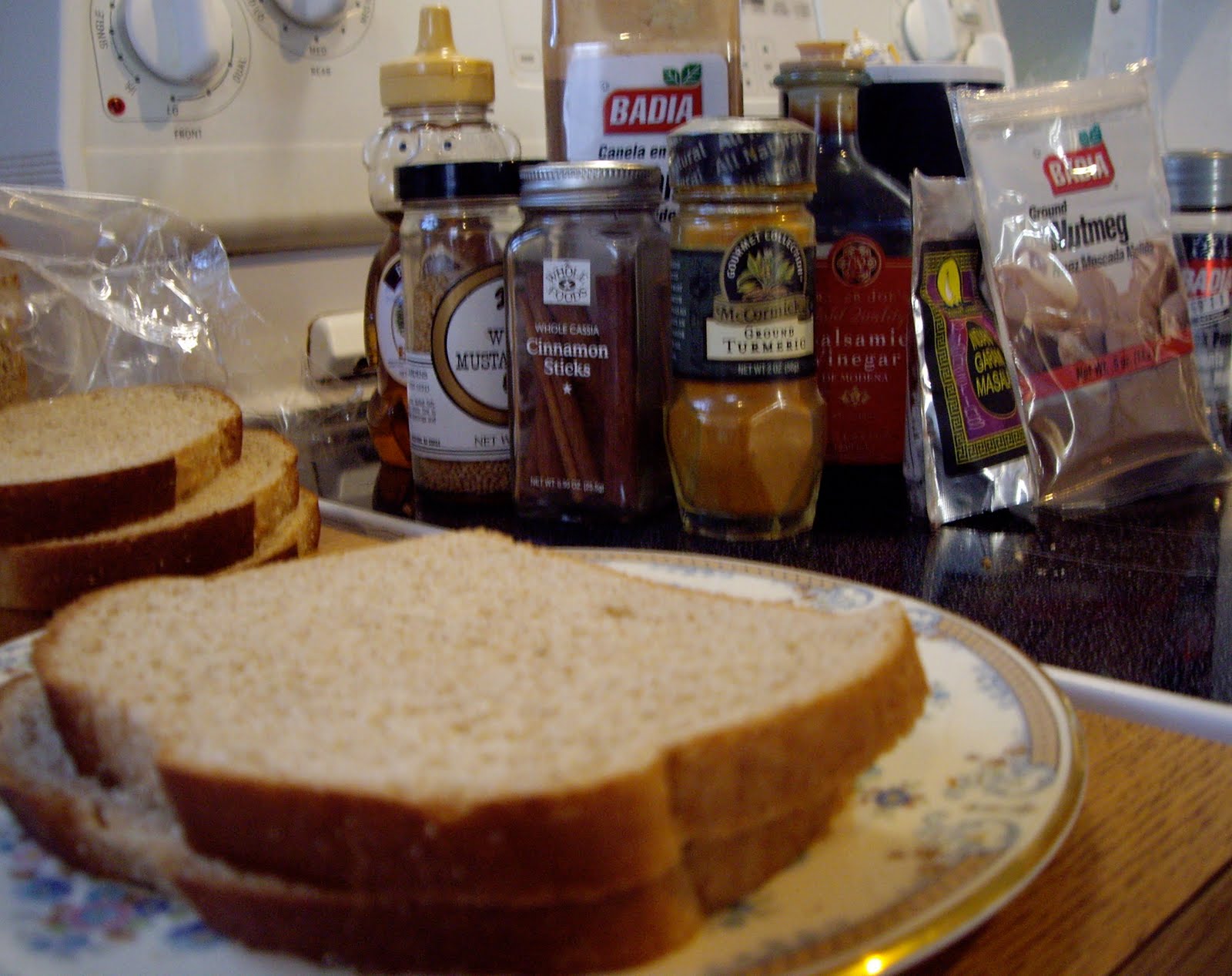
The sandwich, history tells us, was invented in the 18th century by a guy too busy running the British navy to leave his office for a leg of mutton or some home-cooked calves' brains. Also, he was an earl. So when he asked for two pieces of bread with "something chewy in the middle" to be delivered to his desk, people didn't look at him as if he'd just proposed leasing London to the French. They jumped to it, shouting, "You heard the man! Bread! Sliced meat! On the double!"

Circumstances were not so favorable for the 21st-century South Orange, New Jersey dad who may have devised the single most important modification of the sandwich to date. One day this complex and mysterious figure opened the refrigerator to find that some parts of it were far better stocked than others.

"Looks like it may be bread sandwiches for lunch!" he announced to the three kids peering into the depths of the empty meat tray along with him.

"Don't they always have bread?" one of the kids asked warily.

"Daddy means they only have bread," said his older sister in a tone suggesting she'd been down this sort of road before with Daddy.

"Who ever said that a sandwich has to have something in the middle? If a donut had something in the middle, that wouldn't make it a sandwich, would it?"

There was a pause in which the kids pondered this thought-provoking question. It didn't take long for a counter-proposal to emerge.

"Mommy said we could have turkey burgers."

"That sounds," he said gravely, "like something we'd need to cook."

"You just turn on the microwave. The way you do with those funny, star-shaped things you make us."

"You mean my recipe for Chicken D'etoile?"

History is silent about what exactly happened next. But all the evidence points to the kids continuing to lead healthy and productive lives. Meanwhile the dad was left to ponder why for him "cooking light" does not have to do with calories absorbed from food but those expended by the chef during its preparation.

Still, rumors that it was not always so continue to swirl about him. Hadn't Mario Batali stolen several garnishing secrets from him? Didn't the two of them once sneak into Jacques Pepin's villa in order to cook him a surprise dinner of Pork Shoulder Alla Porchetta? OK, a little more plausibly didn't the Dad in question make crepes for his entire family when he was a mere gangly teenager? Having in a moment of weakness confessed the truth of the last to his wife, she brought it up the next time she caught him opening a can of Spaghetti-O's.

"Let's not romanticize the crepes," he replied. "I left stuff out of the recipe."

"Like what? Aren't they pretty much just flour and water?"

"You had to sift the flour. On top of mixing it with the water. Even at 15 I realized that life is too short."

Such reactions are all too common, driving many a talented chef away from the stove. There really should be a cookbook for people who suddenly find themselves not as hungry as they thought when a recipe turns out to have "steps" or "ingredients." (One of each is enough, thank you!) These are also the people who look carefully at the verbs in each step. "Remove from carton" and "leave alone," or even "abandon," are fine. But it's not a good sign if any part of the process involves both "wringing" and "hammering" as in "wring the bird's neck and then hammer until meat is tender." "Whisk" is a direction to be avoided at all costs unless it refers to the dirty dishes and pans that are to be whisked away by someone else.

Remember that you can always simplify an existing recipe, even if it comes from Julia Child, Batali, or one of the other kitchen greats. For instance, a recipe may in theory call for a "delicate" blanching and then sautéing of bacon before mixing it with braised beef. But already the room is spinning, and you haven't even begun to contemplate all the substances that have to simmer and then be boiled down before sunrise. Fortunately, this recipe can itself be boiled down to the following: "gently pick up phone, allow second or two for it to warm to hand temperature, then order pizza." The cooking time for this Jersey classic is approximately half an hour.

Those who seek to run a more efficient kitchen are sometimes intimidated by fancy names. They worry that a person who has been promised Beef Burgundy will not be satisfied to come home to pizza. But the truth is that, if smart, this person will be satisfied to come home to just about anything that he or she does not have to cook.

Remember too that Burgundy is only a place in France. Behind the dish that bears its name is no doubt a story of a Duke of Burgundy who woke up in the middle of the night craving "a tasty stew flavored with an assortment of herbs and roots from the garden." Since this was a Duke, no one said, "You're kidding? It's three in the morning." They started chopping onions as if their lives depended on it. Which they probably did.

The names "sandwich" and "Beef Burgundy" originated because other people started to ask to have "what Sandwich and Burgundy are having." This soon became abbreviated to "I'll have a Burgundy sandwich; hold the lettuce!"—which was confusing. Eventually, however, the two foods sorted themselves out as it became clear that you should never wrap Beef Burgundy in saran, toss it into a full duffel bag, and expect to be able to wear the clothes in it the next day.

Will the bread sandwich catch on in the same way? The fact that, when its inventor refers to the "family home," he is not talking about a castle may hurt its chances. On the other hand, with all the new culinary ground being broken these days, you never know. Already this sandwich has begun to inspire the next generation of chefs. I recently encountered a 10-year-old boy of my acquaintance eating Nutella right out of the jar. When asked what he thought he was doing, he replied that he was having a Nutella sandwich.

"Where's the bread?" I asked, glancing back and forth between the kitchen counter on which he was standing and the unopened loaf on the toaster.

"Who's to say that a sandwich has to have bread? "

Who indeed? I had come across a reference to Chicken Florentine on the Internet and had been vaguely considering the possibility that it might turn out to be what we were having for dinner. But this thought soon passed.

Life really was too short. I'd have what he was having.